
You can drift naturally by anchoring a two-week pattern: pick a consistent bedtime window and a fixed wake time, tightening by 15 minutes if your nightly variability exceeds 30 minutes. Pair soft breathwork with dim, warm lighting and light journaling before gradually relaxing muscles. Hydrate earlier, avoid heavy meals, and log outcomes to refine the sequence. If you follow the data, you’ll uncover where your cues align—and what to adjust next to sleep more steadily.
Key Points
- Build a data-driven sleep window by tracking two weeks of bedtimes, wake times, and perceived sleep onset to tighten variability in 15-minute steps.
- Use Phase One baseline to reduce bedtime variability, stabilizing alignment before advancing to improvements.
- Optimize environment with soft 4-6 breathwork for 5 minutes and dim lighting (below 40 lux or 2700K) to cue relaxation.
- Declutter digital use 60 minutes before bed, add 3–5 minutes of journaling and a brief progressive muscle relaxation.
- Support sleep with light evening snacks as needed, avoid late caffeine, limit alcohol, and log sleep metrics weekly for incremental adjustments.
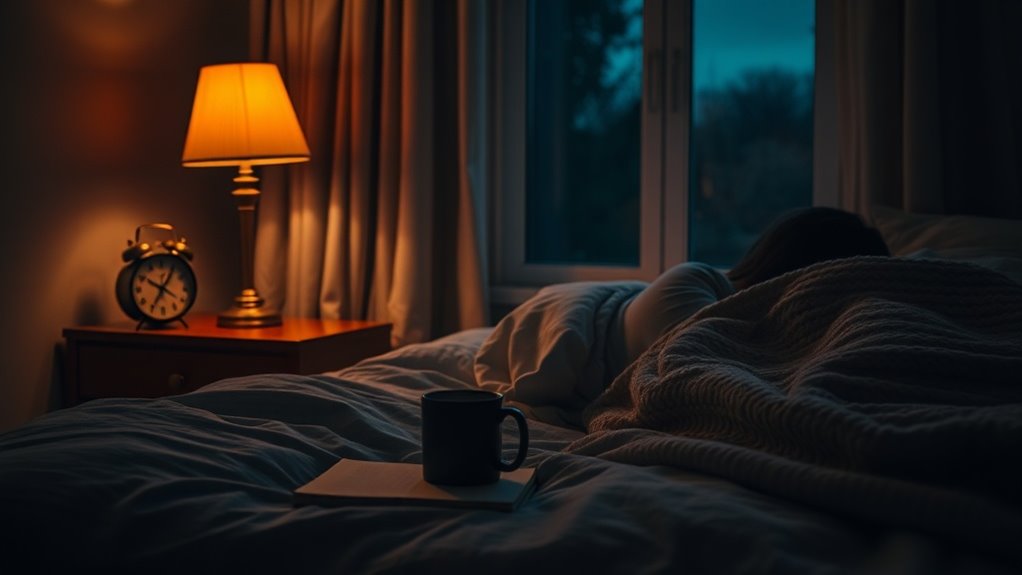
Establishing a consistent nighttime routine signals your body to wind down, improving sleep onset and overall sleep quality. You’ll benefit from a data-driven approach that prioritizes measurable cues over vague intentions. In the first phase, you assess your current window for sleep, aiming for a target bedtime and a fixed wake time. Consistency reduces circadian drift, which studies link to shorter sleep latency and improved sleep efficiency. Track your cues: perceived sleep onset, awakenings, and total sleep time over a two-week baseline. If variability exceeds 30 minutes, tighten your schedule by 15-minute increments until alignment stabilizes.
Establish a consistent sleep window with data-driven cues to reduce circadian drift.
Next, you optimize the environment to support automatic relaxation. Your focus is on two levers with proven impact: soft breathwork and gentle lighting. Soft breathwork lowers sympathetic activity and can shorten sleep onset by reducing racing thoughts. You don’t need formal training; a simple pattern—inhale for four, exhale for six—performed for five minutes yields measurable reductions in perceived arousal. Pair this with gentle lighting: dim the primary lights to below 40 lux, or employ warm color temperatures around 2700K. Lighting history correlates with melatonin onset and improved subjective sleep quality, so you monitor timing and brightness rather than relying on willpower alone.
You then implement a brief digital declutter to minimize cognitive load. You decide on a concrete cutoff for screens—no devices within 60 minutes of bed, or use a blue-light filter if you must engage. Data show that even limited evening screen exposure can delay melatonin release and extend sleep onset. Your routine includes a 3–5 minute journaling or grounding exercise to offload concerns, followed by a short progressive muscle relaxation segment to lower muscle tone and heart rate. You log completion and any sleep impact, creating a feedback loop that reinforces adherence.
Nutrition and hydration are next-frontier controls. You consume a light snack only if you’re genuinely hungry, prioritizing easily digestible options with a small balance of protein and complex carbs. Hydration is maintained earlier in the evening to avoid nocturnal awakenings, as data link late fluid intake with increased wakefulness. You avoid caffeine after mid-afternoon and limit alcohol, recognizing both can fragment sleep architecture even if they initially seem to help.
Consistency is tracked with minimal but meaningful metrics: time in bed, sleep onset latency, and wake after sleep onset. You review weekly trends and set incremental adjustments—up to a 15-minute shift in bedtime to optimize alignment with your circadian phase. Over time, you’ll notice fewer awakenings and shorter wake periods, signaling a more efficient sleep cycle. Your approach remains concise, precise, and data-informed, reinforcing stable patterns without excess ritual. By honoring soft breathwork and gentle lighting as core signals, you establish a predictable physiological cueing system, enabling drift into sleep to occur naturally and efficiently.
Frequently Asked Questions
What Exactly Triggers My Natural Sleep Drift?
Your natural sleep drift is triggered by your brain detecting sleep cues and aligning with circadian signals. As evening light wanes, melatonin rises and body temperature drops, nudging you toward sleep. Consistency reinforces this timing, so regular bed and wake times sharpen these cues. Stress, caffeine, and irregular schedules can blunt them, delaying drift. Prioritize quiet, dim environments and predictable routines to strengthen sleep cues and circadian signals for smoother, faster onset.
Is a Warm Shower Before Bed Essential?
A warm shower isn’t essential, but it helps some people relax and cue sleep. If you persistently struggle, experiment with temperature and duration. Aromatherapy routines and sleep timing consistency often boost winding-down signals, even without a shower. You’ll likely notice better sleep onset when you schedule a regular wind-down with calming scents and a fixed bedtime. Track data: compare nights with and without the shower, note latency and awakenings, and adjust accordingly.
How Long Should Wind-Down Activities Last Nightly?
Wind-down duration should be about 30–45 minutes nightly to support consistent sleep. You’ll notice better sleep onset when you keep this window steady, boosting bedtime consistency. Coincidence shapes the rhythm: you plan the same activities, same order, same timing, and your body learns the cue. Keep the pace steady, your environment calming, and avoid clocks after you start. Track results, adjust in small steps, and maintain the data-driven discipline for lasting consistency.
Do Caffeine or Alcohol Affect Nighttime Drift Differently?
Yes, caffeine and alcohol affect nighttime drift differently. Caffeine timing delays sleep onset by stimulating adenosine receptors, especially if you ingest it late. In contrast, alcohol may make you fall asleep faster but disrupts sleep architecture and reduces REM later in the night. For best drift, avoid caffeine late in the day and limit alcohol, noting caffeine timing and alcohol metabolism vary by person and body weight. Monitor effects to tailor your routine.
Can a Routine Fix Insomnia Overnight?
Can a routine fix insomnia overnight? Not typically. A routine can support sleep, but lasting insomnia relief usually takes multiple days to weeks. You might notice faster sleep drift when you regulate lights, wind-down time, and caffeine timing. Track sleep drift triggers and adjust accordingly. Keep expectations realistic: consistency matters more than quick fixes. If insomnia persists, consult a clinician. Your routine should target sleep hygiene, stimulus control, and stress management for gradual, data-driven relief.